Broadcast vs Listening: Why Your "Speak Up" Culture Might Be Silent |Internal Communications Maturity Model | ARTICLE 2 OF 6
Most organisations believe they listen to their people. Most employees disagree. Here is why that gap exists, and what it actually takes to close it.
Where We Are in the Maturity Model
This article focuses on the transition that defines whether an organisation genuinely progresses beyond Stage Two. If you are new to the series, the diagram below summarises the four stages introduced in Article One. The articles in this series move from left to right. Right now, we are examining the gap between Stage Two and Stage Three: the difference between an organisation that broadcasts and one that genuinely listens.

Stage Two (highlighted in blue) is where most organisations currently sit. Stage Three (highlighted in green) is where this article is pointing.
Ask any senior leader whether their organisation values employee voice, and they will almost certainly say yes. They will mention the engagement survey, the town hall Q&A, and the open-door policy. They will point to the feedback form on the intranet, the anonymous suggestion box, and the CEO's monthly "ask me anything" session.
Ask employees the same question, and you will often get a very different answer.
This gap between leadership belief and employee experience is one of the most persistent and damaging dynamics in organisational communication. It is not driven by bad intentions. Most leaders genuinely want to hear from their people. The problem is structural, cultural, and often invisible to those sitting at the top.
In this article, we explore the difference between broadcasting and genuine listening: why so many "Speak Up" cultures are actually silent, what real listening requires in practice, and how organisations can begin to close the gap between the two.

The Broadcast Default
Broadcasting is the natural starting point for most organisations. It is efficient, controllable, and easy to measure. You send a message. You track whether it was opened. You report the numbers. Done.
The broadcast model suits a particular view of the employment relationship: management decides, and employees are informed. Even in organisations that have moved well beyond this view in principle, the infrastructure often still reflects it. The intranet is built to push content, not collect it. The town hall is designed for leadership presentations, with a few minutes for questions at the end. The engagement survey is run once a year, and the results are presented back to employees several months later in a format that tells them what leadership found interesting.
None of this is malicious. It is simply the path of least resistance. Broadcasting is logistically easier than listening, and its outputs are easier to demonstrate to stakeholders. "We sent 42 communications last quarter" is a straightforward sentence. "We genuinely understood what 4,000 employees were thinking and feeling" is much harder to say with confidence.
The Illusion of Listening
The more insidious problem is not pure broadcasting. It is the organisations that believe they are listening when they are not. This is the illusion of listening, and it is far more difficult to address than simple broadcast-led communication, because it requires leaders to question assumptions they have already decided are settled.
The illusion of listening takes several recognisable forms:
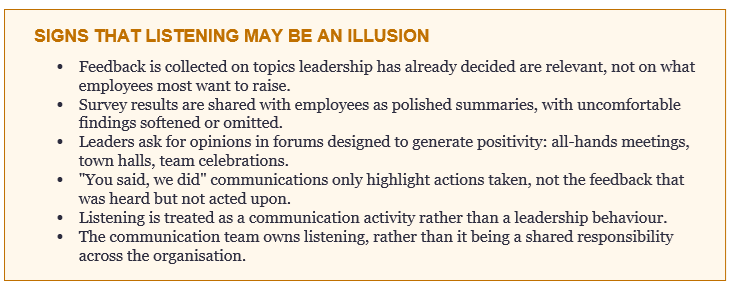
The effect of the illusion of listening is often worse than no listening mechanism at all. When employees take the time to share an honest view, and nothing changes, and no one explains why, trust erodes. The next survey response rate drops. People stop raising issues informally. The organisation gradually loses access to the very intelligence it needs to function well.
What Genuine Listening Actually Requires
Genuine listening is not a channel or a tool. It is a set of behaviours, structures, and cultural norms that create the conditions for honest communication. It requires four things that broadcast-led organisations typically lack.
1. Psychological Safety
Employees will not say what they actually think unless they believe it is safe to do so. Psychological safety is the shared belief that the team or organisation will not punish or embarrass someone for speaking up, asking a question, or flagging a concern.
It is built slowly and destroyed quickly. A single incident where a manager responds defensively to critical feedback, or where an employee is visibly sidelined after raising a concern, can silence dozens of others who were watching.
Building psychological safety is a leadership behaviour, not a communication campaign. You cannot send an email that creates it. It is built through consistent, repeated demonstrations that honesty is welcomed, not just tolerated.
2. Accessible and Varied Channels
Different people communicate differently. Some employees are comfortable writing a considered response to a survey. Others will only ever share a view in a small, trusted group conversation. Others need anonymity before they will say anything candid at all.
A genuine listening infrastructure offers multiple access points: structured and informal, anonymous and attributed, digital and face-to-face. It does not assume that everyone who did not respond to the survey had nothing to say.
Modern organisations should also pay close attention to enterprise social networks such as Viva Engage, Slack, and Microsoft Teams. These platforms generate a continuous, largely unsolicited signal about what employees care about. Monitoring them thoughtfully, not to police what people say but to understand what is genuinely on people's minds, can surface concerns long before they appear in a formal survey.

Timing matters as much as channel. Asking for feedback at the end of a major change, once decisions have been made and implemented, captures opinion but not influence. Listening that genuinely affects decisions happens much earlier in the process.
3. Transparency About What Happens Next
One of the most consistently cited reasons employees stop engaging with feedback mechanisms is the belief that nothing ever changes. Whether or not this is objectively true, it is the perception that matters.
Organisations that listen well close the loop visibly and honestly. This does not mean acting on every piece of feedback. It means explaining clearly what was heard, what has been decided, and why. It means being honest when a view was noted but not acted upon, and giving a genuine reason rather than a corporate deflection.
This transparency requires courage from leaders. It is much more comfortable to share a "you said, we did" summary than to say: "We heard your concerns about the restructure, we understand why you feel that way, and we are proceeding anyway for the following reasons." But the second approach, done with care and respect, builds more trust than the first.
4. Leadership Behaviour, Not Just Communication Structure
This is perhaps the most important point, and the one most frequently overlooked. Listening is not primarily a communication function responsibility. It is a leadership behaviour.
Senior leaders who are genuinely curious about what employees think, who seek out perspectives that challenge their own, who acknowledge when front-line feedback has changed a decision: these leaders create organisations where people feel heard. No amount of survey infrastructure compensates for senior leaders who are visibly uninterested in, or defensive about, what employees actually think.
The communication team can create the channels and the frameworks. But the culture of listening is modelled from the top, and employees watch leadership behaviour far more carefully than they read communication policies.

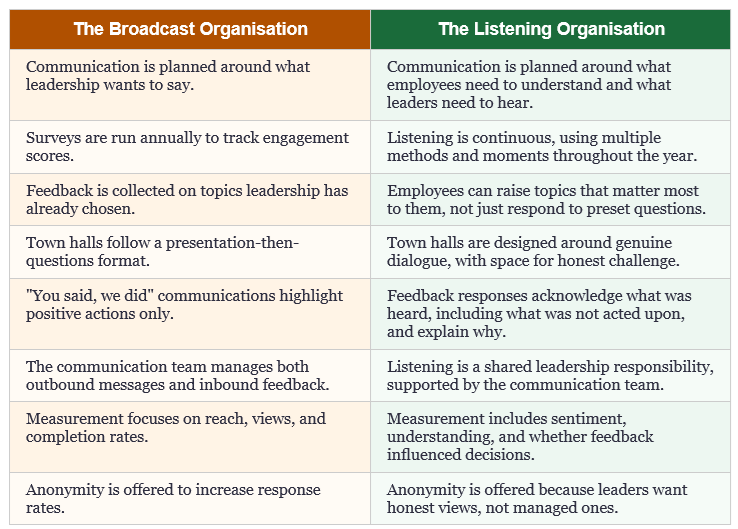
Broadcast vs Listening: A Practical Comparison
The difference between a broadcast organisation and a listening organisation is not always about the tools they use. Often, both use similar channels. The difference lies in intent, design, and what happens after the message is sent or the feedback is received.
The "Speak Up" Culture Trap
Many organisations invest heavily in creating what they call a "Speak Up" culture. They launch campaigns encouraging employees to raise concerns, share ideas, and challenge the status quo. They create ethics hotlines, idea platforms, and open-door policies. They tell new starters in onboarding that their voice matters.
And yet, in practice, the culture remains quiet. Why?
The answer is almost always the same: the organisation has built the infrastructure for speaking up without addressing the conditions that make it safe and worthwhile to do so. A "Speak Up" campaign is a broadcast activity. It tells people they are welcome to speak. It does not create the psychological safety that makes speaking feel genuinely risk-free, and it does not demonstrate that speaking up will lead to anything changing.
Worse, a visible "Speak Up" campaign in an organisation that has not done the underlying cultural work can actively increase distrust. When employees see a glossy poster about raising concerns and know from experience that the last person who raised a concern was quietly managed out, the dissonance deepens. The gap between the stated culture and the lived culture becomes impossible to ignore.

That is a difficult thing to say publicly within an organisation. It requires a leader who is willing to acknowledge that the culture is not yet where it needs to be, and to take the time to build the foundations before making promises the organisation cannot keep.
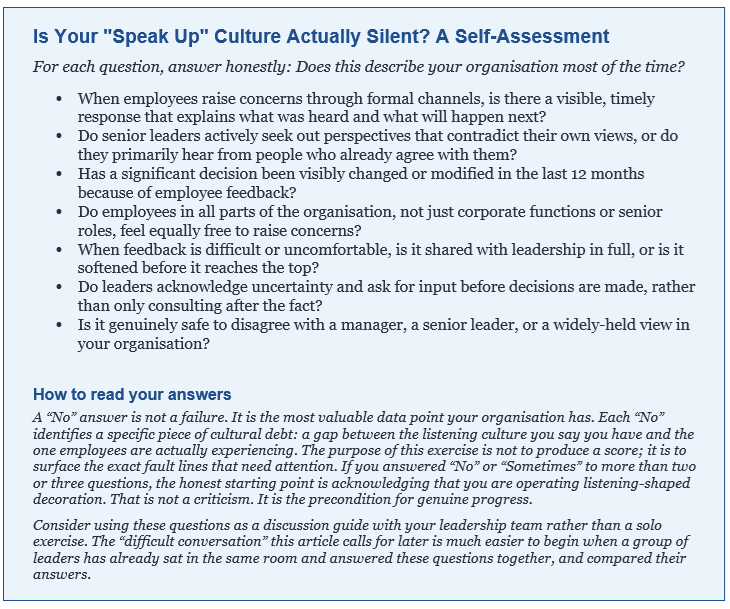
Beginning the Shift: From Broadcast to Listening
The shift from a broadcast to a listening organisation is not achieved through a single initiative. It is a cumulative change in behaviour, structure, and culture. The following are practical starting points for organisations at Stage Two who are ready to begin the journey.
Start With an Honest Audit
Before launching new listening initiatives, take stock of the ones you already have. For each mechanism currently in use, ask three questions: Who can access it? What happens to the feedback? And how do employees know it was heard?
The answers are often revealing. Many organisations discover that their listening mechanisms are well-designed in theory but rarely deliver honest intelligence in practice. Starting with an audit prevents the common mistake of adding more channels before fixing the ones that already exist.
Separate Listening From Messaging
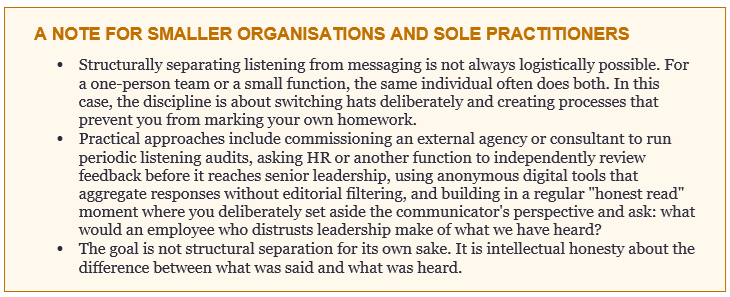
One of the most practical structural changes an organisation can make is to separate the mindset, and where possible the responsibility, for outbound communication from the work of listening and insight.
When the same person or team is responsible for crafting leadership messages and collecting employee feedback, there is an inherent tension. The instinct to protect the message can subtly distort what gets passed upward. Organisations that take listening seriously often create a distinct internal research or insight function, or bring in external support to run listening programmes independently of the communication team.
Build Listening Into Decision-Making Processes
The most powerful signal an organisation can send about the value of employee voice is not a campaign. It is a process change. When employee feedback is formally embedded in how major decisions are made, people see that listening is structural rather than ceremonial.
This might mean that change programmes require a listening phase before the communication plan is written. It might mean leadership teams receive a monthly sentiment briefing that informs their priorities. It might mean the communication team is present in strategy conversations specifically to represent the employee perspective. These are structural changes, and they carry far more weight than any campaign.
Acknowledge What You Hear, Including the Uncomfortable Parts
Nothing builds a listening culture more effectively than seeing a leader stand up and say: "We asked, you told us something we did not want to hear, and here is how we are going to address it."
Conversely, nothing destroys it more quickly than seeing feedback collected, processed, summarised, and then quietly shelved.
Organisations do not need to act on every piece of feedback to demonstrate that they are listening. They need to acknowledge it honestly. The distinction matters enormously to employees, and it is a discipline that most organisations have not yet developed.

What This Means for Your Maturity Journey
In the context of the maturity model, the broadcast-to-listening shift represents the defining transition from Stage Two to Stage Three. It is the point at which internal communication stops being primarily about message delivery and starts being about genuine understanding.
Organisations at Stage Two often have sophisticated communication channels and high levels of activity. But if those channels only flow in one direction, if the town hall is a presentation rather than a conversation, if survey results are filtered before they reach senior leadership, the organisation is still broadcasting, regardless of how it describes itself.
Moving to Stage Three requires investment in three areas simultaneously:
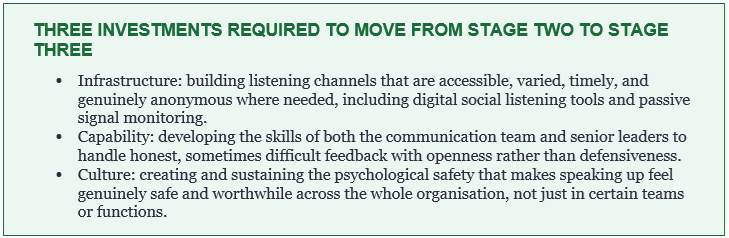
None of these investments produces instant results. Building a listening culture is a long-term endeavour that requires consistent leadership behaviour over time. But the organisations that commit to it find that the intelligence they gain from genuinely listening changes their decisions, reduces the cost and friction of major change programmes, and builds the kind of employee trust that is very difficult to manufacture through communication activity alone.
The Silence Is Telling You Something
If your organisation runs listening mechanisms and employees are not using them, or are using them to say everything is fine when you suspect it is not, that silence is itself a signal. It is telling you that the conditions for genuine honesty do not yet exist.
The response to that signal is not a better survey or a louder "Speak Up" campaign. It is a serious, honest examination of the leadership behaviours, structural barriers, and cultural norms that are keeping people quiet.
That examination is difficult. It requires leaders to question their own behaviours, not just the communication team's outputs. It requires the communication function to move from message management to insight generation. And it requires the organisation to be willing to hear and respond to what its people actually think.
That is the real shift from Stage Two to Stage Three. And it is the most important journey most organisations will take.

Is your organisation stuck in the Broadcast Default, measuring reach instead of real sentiment? I help leadership teams move beyond Stage Two of the Maturity Model by building the infrastructure and psychological safety required for genuine listening. If you are ready to turn employee silence into actionable insight, let’s discuss how I can support your transition to Stage Three.
For consultation enquiries:
Muhammad Farhan Aslam MCIM, MCIPR
Principal Consultant: Communications, Marketing and Engagement
Email: info@commsxpert.com | LinkedIn: linkedin.com/in/faslam/ | Web: commsxpert.com
Next in the series: Article 3: The Stage Two Trap: Why most companies fail to move past basic broadcasting
#InternalComms #Leadership #EmployeeEngagement #CompanyCulture #MaturityModel #CommsXpert #MuhammadFarhanAslam