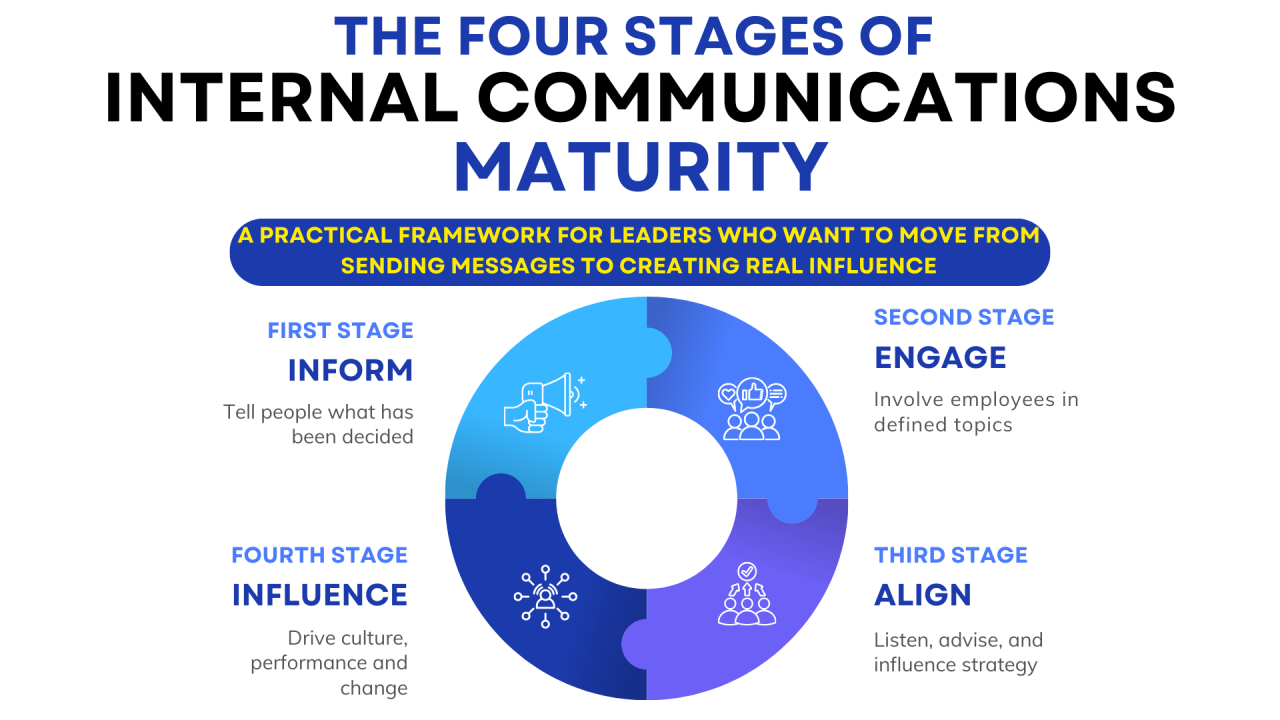
The Four Stages of Internal Communications Maturity | Internal Communications Maturity Model Series | Articles 1 to 6
A practical framework for leaders who want to move from sending messages to creating real influence
Internal communication is no longer a support function. In high-performing organisations, it is a strategic capability that shapes culture, builds trust, and drives business results.
Yet most organisations are still operating well below their potential. Communication teams are brought in late, given limited influence, and measured on outputs rather than outcomes. Leaders broadcast rather than listen. Employees receive information but do not feel genuinely informed.
This does not happen because people lack effort or commitment. It happens because there is no shared map of what good looks like, and no honest conversation about where the organisation actually is.
That is the purpose of this series. Over six articles, we will walk through the Internal Communications Maturity Model, a practical framework drawn from decades of consulting experience across organisations of all sizes and sectors. We will explore not just the what of each stage, but the why behind the patterns that hold organisations back, and the specific actions that help them move forward.
Why a Maturity Model?
Maturity models exist because progress rarely happens in a straight line. Organisations grow, restructure, face crises, and change leadership. A maturity model gives everyone involved in communication, whether in the team itself or in senior leadership, a shared language for describing the current state of play.
It serves several practical purposes:
- It helps leaders understand where they are, not just where they would like to be.
- It identifies the gaps in capability, governance, and culture that are holding the function back.
- It builds the case for investment in the right people, processes, and technologies at the right time.
- It reframes internal communication as a discipline with a measurable trajectory, rather than a collection of tasks.
Most importantly, a maturity model shifts the question from "Are we sending enough messages?" to "Are we creating the understanding, trust, and engagement that the business needs?"
That is a fundamentally different question, and it demands fundamentally different answers.
The Four Stages at a Glance
The model identifies four distinct stages of internal communications maturity. Most organisations pass through them in order, though the speed of progression varies considerably. Some organisations skip stages under pressure; others regress when leadership changes or investment is withdrawn.
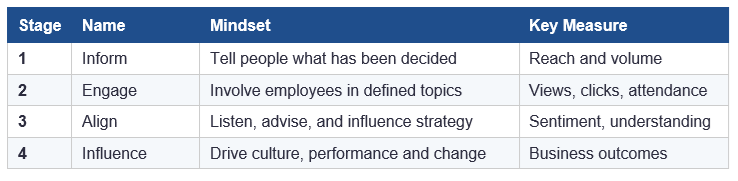
STAGE ONE | Inform
Communication as an order-taking service
What it looks like
- Messages are sent reactively, in response to requests rather than strategy.
- The team, if it exists, is small, under-resourced, and rarely involved in planning.
- Channels are basic: all-staff emails, noticeboards, and printed bulletins.
- Leaders communicate sporadically, often only in a crisis.
- There is no meaningful measurement and no feedback loop.
- Communication is seen as administrative support, not a strategic function.
Organisational impact
Employees receive information, but they do not feel informed. Messages are inconsistent, and trust in leadership is often low. Communication feels like background noise rather than genuine engagement. The risk is that important messages are missed, misunderstood, or simply disregarded.
STAGE TWO | Engage
Communication as a channel management exercise
What it looks like
- Annual communication plans exist, though they are not always followed.
- Channels are more organised: intranets, team briefings, leadership updates, surveys.
- The language shifts from "we are announcing" to "we want to hear from you."
- Campaigns, branding initiatives, and content calendars are introduced.
- Measurement focuses on clicks, views, and attendance figures.
- Employee voice is encouraged, but feedback rarely changes anything.
Organisational impact
Employees feel better informed, but not necessarily engaged. Engagement scores may rise initially, then plateau. The organisation talks more than it listens. A subtle cynicism begins to take hold when employees see their opinions asked for but rarely acted upon. This is the stage where most organisations get stuck, and the stage most likely to be mistaken for genuine progress.
STAGE THREE | Align
Communication as a strategic business function
What it looks like
- Communication strategy is developed alongside business strategy, not after it.
- Leaders understand their role as communicators and receive structured support.
- Listening is continuous: feedback loops, focus groups, and sentiment analysis.
- The team uses data and insight to advise leaders and shape decisions.
- Measurement includes sentiment, understanding, and behaviour, not just reach.
- Governance frameworks, content standards, and channel policies are in place.
Organisational impact
Employees feel heard, valued, and genuinely connected to the organisation's purpose. Leaders make better decisions because they are informed by front-line reality, not just boardroom assumptions. Communication supports change programmes, strengthens culture, and begins to demonstrably improve performance. Trust starts to build in a meaningful, sustained way.
STAGE FOUR | Influence
Communication as a driver of competitive advantage
What it looks like
- Communication is embedded across the organisation, not siloed in a function.
- The Head of Communications sits at the top table to help shape strategy, not just deliver it.
- Employee voice actively shapes decisions at every level of the organisation.
- Communication, HR, strategy, and operations work in genuine partnership.
- Measurement is sophisticated and linked directly to business outcomes.
- Leaders communicate with confidence, consistency, and authentic purpose.
Organisational impact
Employees trust leadership, understand priorities, and feel genuinely part of the organisation's future. The business adapts to change faster because information flows freely and honestly. Top talent is retained because people feel connected to the mission. Communication becomes the connective tissue that holds the organisation together during difficult periods, and a quiet but significant competitive advantage.
Where Most Organisations Actually Sit
Honest self-assessment is harder than it sounds. Most leaders, when asked, will place their organisation at Stage Two or Three. They will point to the intranet, the engagement survey, and the town halls. They will talk about "two-way communication" and "listening culture."
But the test is not what the communication team does. The test is what employees experience.
Do employees genuinely believe that when they raise concerns, something changes? Do leaders seek out perspectives before decisions are made, or do they consult after the fact to tick a box? Does the communication team help shape strategy, or do they find out about it the same day as everyone else?
The gap between aspiration and reality is where the maturity model does its most important work.

The Hardest Transition: From Stage Two to Stage Three
Of all the transitions in the model, the move from Stage Two to Stage Three is consistently the most difficult. It is not a technical challenge; it is a cultural and political one.
At Stage Two, the communication function is visible, active, and often appreciated. It runs the intranet. It produces the newsletter. It organises the town hall. Leaders know who to call when they need something written. There is a comfortable, settled rhythm.
Moving to Stage Three means disrupting that rhythm. It means the communication team asks to be involved in strategy conversations before the message has been decided. It means challenging leadership on how decisions will land before those decisions are announced. It means investing in listening infrastructure that generates data that leaders may find uncomfortable.
This requires both capability and courage, from the communication team and from the senior leaders who sponsor them. We will explore this transition in detail in Article Three of this series.
What This Series Covers
This article is the foundation. The five articles that follow build on it:
- Article 2: Broadcast vs Listening explores why so many "Speak Up" cultures are actually silent, and what genuine listening requires in practice.
- Article 3: The Stage Two Trap examines why most organisations fail to move past broadcast-led communication, and the specific barriers that keep them stuck.
- Article 4: Governance and Guardrails sets out the structures that mature communication functions need in order to remain agile without becoming chaotic.
- Article 5: Building the Dream Team addresses how to hire and upskill a communication team capable of operating at Stage Three and beyond.
- Article 6 (Bonus): The ROI of Maturity makes the commercial case by linking high-quality internal communication directly to business performance.
Each article can be read as a standalone piece, but the series is designed to be read in order. The model builds progressively, and later articles assume familiarity with the foundations laid here.
A Note on Self-Assessment
As you read through the stages, resist the temptation to benchmark against your ambitions. Benchmark against the evidence.
Ask your employees, not just your team, what communication feels like from where they sit. Look at the data you actually have, not the data you wish you had. Talk to leaders outside the communication function about how they view its role.
In our experience, organisations that are willing to be honest about being at Stage One or Stage Two make far faster progress than those that claim Stage Three while operating at Stage Two. Self-awareness is the precondition for genuine development.
The First Step Is an Honest Conversation
Understanding the maturity model is not the goal. The goal is to know what to do with that understanding.
Whether your organisation is at Stage One or Stage Three, there are always specific, practical steps you can take to move forward. The model gives you a map. The articles that follow give you the tools to navigate it.
In Article Two, we will take a close look at one of the most common and consequential gaps in internal communications maturity: the difference between an organisation that broadcasts and one that genuinely listens. It is a distinction that shapes almost everything else, and it is the place where the real journey begins.
Next in the series: Article 2: Broadcast vs Listening: Why your "Speak Up" culture might be silent
Internal Communications Maturity Model Series | Articles 1 to 6
#InternalComms #Leadership #EmployeeEngagement #Strategy #CompanyCulture #CommsXpert #MuhammadFarhanAslam