The Stage Two Trap: Why Most Companies Fail to Move Past Basic Broadcasting|Internal Communications Maturity Model | Article 3 of 6
The most dangerous place in the maturity model is not Stage One. It is Stage Two: busy enough to feel like progress, but structured in a way that makes real progress almost impossible.

This article focuses on Stage Two: why organisations get stuck there, what the trap actually consists of, and what it takes to break out of it. The diagram below shows where Stage Two sits in the model. Most organisations are here. Very few recognise it as a problem.
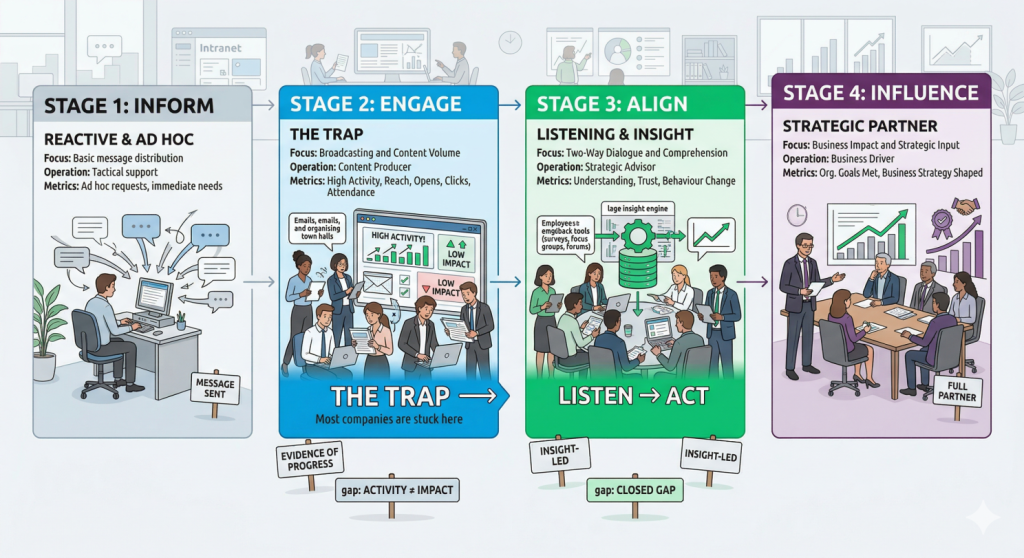
Stage Two (highlighted in blue) is labelled "The Trap" in this article for a reason that will become clear. Stage Three (green) is where the path leads, but getting there requires understanding precisely why Stage Two holds on so tight.
There is a particular kind of organisational frustration that communication professionals know well. You have built the channels: the intranet, the newsletter, the town halls, the engagement survey, and the manager briefing toolkit. The team is working hard. Leadership is broadly supportive. And yet something is not working. Employees do not feel informed. Trust is not improving. Change programmes are taking longer than they should. The survey scores plateau.
The natural response is to do more: more content, more campaigns, more channels, more frequency. Activity increases. The team gets busier. The reporting looks healthier. But the underlying problem does not shift.
This is the Stage Two Trap. And it is one of the most common and most costly patterns in internal communications.

Stage Two feels like progress because, in many ways, it is. Compared to the reactive, ad hoc communication of Stage One, Stage Two organisations have real infrastructure: planned calendars, defined channels, a visible team, and some measurement. Leaders know who to call when they need to communicate something. There is a rhythm.
That comfort is part of the problem. Stage Two is defensible. When budgets are reviewed or headcount is questioned, the Stage Two communication function can point to a lot of activity. It can show the number of emails sent, the intranet page views, and the town hall attendance figures. It looks, from the outside, like a functioning operation.
But stability is not the same as effectiveness, and activity is not the same as impact. The Stage Two Trap is the gap between those two things, sustained indefinitely because the organisation has found a way to be comfortable with the gap rather than uncomfortable enough to close it.
The Activity-Impact Confusion
At the heart of the trap is a measurement problem. Stage Two organisations typically measure what is easy to measure: reach, opens, clicks, attendance, and content volume. These metrics are not worthless, but they are incomplete. They measure transmission, not comprehension. Presence, not impact. They tell you whether the message was sent, not whether it was understood. They tell you whether employees attended the town hall, not whether they left with greater clarity or trust.
When the metrics look reasonable, there is no trigger for change. Leaders see the reporting, observe that messages are being sent and attended to, and conclude that communication is working. The communication team, measured on the same outputs, has little incentive to raise the question of whether the underlying approach is right.
This is not a failure of honesty. It is a structural problem: the organisation has built its definition of communication success around the wrong measures, and then organised itself to optimise for those measures.


Stage Two is not a single problem. It is a cluster of interlocking patterns, each of which reinforces the others. Understanding them individually makes it easier to identify which ones are present in your organisation, and which to address first.
Trap ONE | The Busy Team Problem
When a team is fully occupied producing content, there is no capacity to question whether that content is working.
How to recognise it
- The communication team’s workload is driven entirely by requests from other departments.
- Strategic thinking is squeezed out by reactive production.
- Team members rarely have time to speak directly to employees or gather genuine insight.
- Success is measured by how much was produced and delivered, not by what changed as a result.
- New channels are added to the function's responsibilities without any channel being decommissioned.
Trap TWO | The Leadership Bottleneck
When senior leaders see communication as something done to employees rather than with them, the function is limited from above.
How to recognise it
- Leaders instruct the communication team on what to say and how to say it, rather than seeking their counsel on strategy.
- Difficult messages are softened or delayed by leadership before they reach employees.
- Leaders are inconsistent communicators: engaged during campaigns, absent the rest of the time.
- The communication function is not present in senior leadership discussions until the message has already been decided.
- There is no accountability for leaders whose communication behaviour undermines organisational trust.
Trap THREE | The Measurement Trap
When the metrics reward activity rather than impact, the organisation optimises for the wrong things.
How to recognise it
- Communication reports focus on volume: number of emails, page views, and town hall attendance.
- Engagement survey results are treated as a verdict on the communication function rather than a signal about organisational culture.
- Senior leaders ask, "Did we tell them?" rather than "Do they understand?"
- No one is measuring whether employee behaviour or decision-making changed as a result of communication.
- Insight and analytics capability are limited or absent within the communication function.
Trap FOUR | Performative Listening
When listening mechanisms exist but do not genuinely influence decisions, employees learn to treat them as theatre. Worse, there is a trust tax: asking for feedback and failing to act on it does more damage than never asking at all. It signals that the organisation values the appearance of listening more than the reality of it.
How to recognise it
- Employee forums, ambassador networks, and feedback sessions are well-attended but rarely change anything.
- Survey results are communicated back to employees as summaries of what leadership plans to do, rather than acknowledgements of what was heard.
- Difficult or critical feedback does not reach senior leadership in its original form.
- Employees are consulted after decisions are made, not before.
- "You said, we did" Communications are celebrated internally, but employees struggle to name a single significant change that resulted from their feedback.
Trap FIVE | The Structural Exclusion
When the communication function is not involved in strategy, it can only react to it. Reactive communication is almost always less effective than planned communication.
How to recognise it
- The communication team learns about major decisions at the same time as employees, or only slightly ahead.
- There is no formal process for involving the communication function in change management or business planning.
- Communication plans are written after strategies are set, rather than being part of how strategies are developed.
- Senior leaders do not routinely seek communication counsel before making announcements or launching initiatives.
- The Head of Communications does not have a seat at the senior leadership table, or attends only for relevant agenda items.
Each of these traps is damaging on its own. But their real power lies in how they combine.

These five patterns are not independent. They form a self-sustaining system. A team consumed by reactive production work (Trap One) has no time to build the insight capability that would demonstrate impact (Trap Three). Leadership that controls the message (Trap Two) prevents the genuine dialogue that would build trust (Trap Four). A function that is structurally excluded from strategy (Trap Five) cannot challenge the measurement framework that keeps it stuck (Trap Three).
The result is a closed loop. Each pattern makes the others harder to address. The organisation is not failing to progress because people lack effort or intelligence. It is failing to progress because the system is stable, and stability, in this context, is the enemy of development.
Breaking out of Stage Two requires disrupting the system, not just improving individual components of it. That is why adding more channels, or hiring more resources, or running another campaign rarely works on its own. The problem is not one of capacity. It is one of the structures, culture, and leadership behaviours.


There is a reason most organisations stay at Stage Two. It is not incompetence. It is not a lack of ambition. The reason is that moving beyond Stage Two requires things that are genuinely hard.
It requires senior leaders to accept a more uncomfortable relationship with their communication function: one where the communication professional challenges decisions before they are made, raises concerns about how a message will land, and reports honestly on what employees are thinking rather than what leadership would like to hear.
It requires the organisation to invest in listening and insight infrastructure that will sometimes surface uncomfortable findings. And it requires a willingness to act on those findings, even when acting is inconvenient or costly.
Most of all, it requires leaders to change their behaviour. Not their policies or strategy documents: their actual, day-to-day behaviour as communicators. That is the hardest change of all, and the one that no communication campaign can deliver on its own.
Are You in the Trap? A Diagnostic
These are the questions that Stage Two organisations find most uncomfortable to answer. Work through them individually first, then use them as a discussion guide with your senior leadership team.
- When was the last time a senior leader publicly changed their position on something because of employee feedback?
- Does your communication team see the business strategy before it is finalised, or after?
- What percentage of your internal communication budget is allocated to listening and insight, versus producing and distributing content?
- If your engagement survey results are disappointing, what happens? Is the methodology questioned, or are the findings acted upon?
- Do frontline employees have a direct route to raise concerns with senior leadership, and does it feel genuinely safe to use it?
- Has any manager in your organisation faced consequences in the last 12 months for consistently poor communication behaviour?
- Could you describe, right now, the three things that are most on your employees’ minds this week? If not, how would you find out?
- What do employees say about leadership communication when leaders are not in the room?
How to read your answers
If you answered “No” or “Don’t know” to more than three of these, your function is likely operating in the Stage Two Trap. If these questions feel difficult or exposing, that discomfort is itself the diagnosis. The organisations that find them easy to answer have usually already moved beyond Stage Two. Consider using them as a discussion guide with your leadership team; the conversation they provoke is often more valuable than the individual answers.

Moving from Stage Two to Stage Three is not a project. It is a shift in how the organisation understands what communication is for, and that shift has to happen at the senior leadership level before it can happen anywhere else.
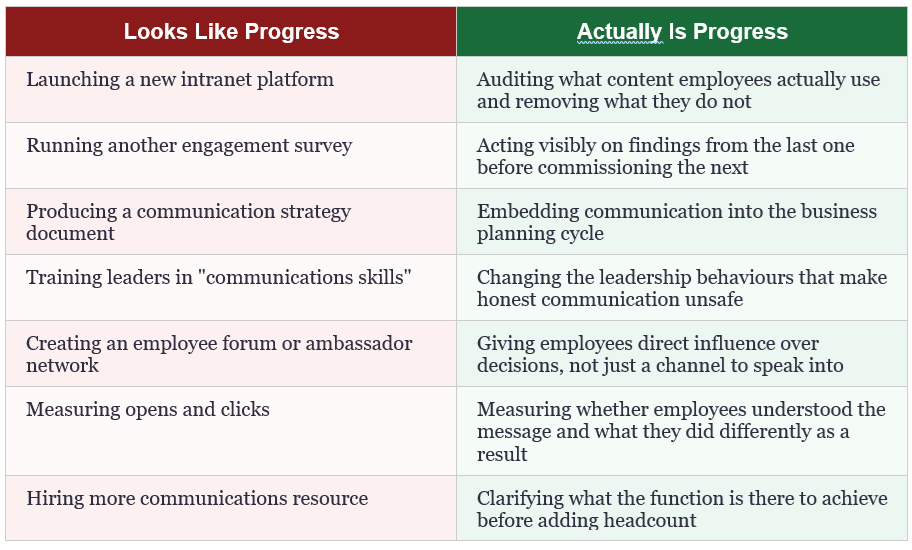
The table below distinguishes between actions that look like progress and actions that actually produce it. Many Stage Two organisations make the mistake of choosing from the left-hand column and wondering why the results do not follow.
The Role of the Communication Leader
One of the most important, and least comfortable, implications of this analysis is that the communication function itself must change how it operates. A team that has spent years optimising for Stage Two will need to develop new skills, new habits, and a new relationship with the leadership it serves.
The move from Stage Two to Stage Three requires the communication leader to make a fundamental shift: from delivery to counsel, from activity to insight, and from execution to influence. That means being present in strategy conversations before decisions are made, interpreting listening data and presenting it directly to leadership, and challenging the assumptions that have kept the function in a supporting role.
This is a significant professional shift. It requires courage, political skill, and strong relationships with senior sponsors. It also requires the communication leader to have an honest conversation with themselves about whether their team is currently structured and skilled to operate at the level Stage Three demands. We will return to this in Article Five.
The Role of Senior Sponsorship
No communication function moves from Stage Two to Stage Three without active sponsorship from at least one senior leader who genuinely believes in the value of strategic communication. That sponsor does not need to be the CEO, although CEO endorsement helps. They need to be someone with enough influence to change the conversations that happen before decisions are made.
Finding and cultivating that sponsor is often the communication leader's most important priority at Stage Two. It is more important than any channel improvement, any new platform, or any measurement framework. The channel problems will not solve themselves, but they are far easier to address once there is a leadership champion making the case internally.

What You Can Do This Week
Five actions to test whether you are in the trap, and begin to move out of it. Categorised by role, though most are worth reading regardless of where you sit.
For Senior Executives
- Ask your communication team: “What is the most important thing happening here right now that we are not talking about internally?” If they hesitate, that hesitation is the diagnosis.
- Identify the most senior leader widely regarded as a poor communicator. Ask yourself: has anyone ever had a frank conversation with them about the impact of their behaviour? If not, ask why not.
For Communication Leads
- Review your last three campaigns. For each, identify what was measured. If the answer is only reach or attendance, plan one follow-up that measures understanding or behaviour change instead.
- Pull up your function’s current KPIs. Count how many measure output versus outcome. Rewrite one output metric as an outcome metric before the end of this week.
- Have a conversation with your CHRO or a trusted HR business partner. Ask what they are hearing from employees that your team does not know about. The gap between those two pictures is the intelligence you are missing.
The trap is not permanent. But it does not resolve itself, and it does not respond to incremental improvement within the existing model. It responds to deliberate, leadership-level decisions to change the way internal communication is understood, resourced, and measured.
The organisations that make those decisions tend to share a common starting point: a senior leader or a communication professional, sometimes both, who becomes sufficiently uncomfortable with the gap between what communication could be and what it currently is.
That discomfort is the beginning of the escape. The diagnostic questions in this article are designed to help produce it. The articles that follow are designed to help you know what to do with it once you have it.

Most organisations do not have a communication problem; they have a structural one. They are busy, but they are stuck.
I partner with organisations to dismantle the Stage Two Trap, helping you shift from a function that merely broadcasts to one that drives genuine business alignment and strategic influence. Whether you are navigating a complex change programme, merging internal and external narratives, or struggling to move beyond basic engagement metrics, I provide the external perspective and deep expertise needed to disrupt the status quo.
With 29 years of experience across internal, change, and external communications, I help you bridge the gap between sending a message and ensuring it is understood. This might involve:
- A Maturity Diagnostic: Identifying exactly which of the five traps are holding your team back.
- Strategic Counsel: Seating communications at the leadership table to influence strategy before announcements are made.
- Outcome-Led Frameworks: Replacing vanity metrics (clicks and opens) with measures of comprehension, trust, and behaviour change.
- Change Management Support: Navigating the cultural and leadership shifts required to move from "broadcasting" to "listening".
The organisations that escape Stage Two don't just work harder; they work differently. They stop measuring how busy they are and start measuring how much they have moved the needle.
When you are ready to move beyond the trap, I offer three ways in:
- A Diagnostic Conversation: 30 minutes to identify the primary patterns keeping your organisation stuck.
- A Communication Maturity Audit: A deep dive into your structure, metrics, and channels to provide hard evidence for change.
- Strategic Partnership: Ongoing support to coach your leaders and transform your communications into a high-impact, strategic partner.
The door is open when you are ready to stop broadcasting and start influencing.
For consultation enquiries:
Muhammad Farhan Aslam: MCIPR, MCIM
Principal Consultant: Communications, Marketing & Engagement
📧 info@commsxpert.com | 🔗 commsxpert.com
📧 fa@farhanaslam.co.uk | 🔗 linkedin.com/in/faslam/
In Article Four, we turn to governance and structure: the frameworks that mature communication functions need in order to operate strategically without losing the agility that makes them effective.
Next in the series: Article 4: Governance and Guardrails: The structure of mature functions need to stay agile
#InternalCommunications #CommsXpert #MuhammadFarhanAslam #StrategicComms #MaturityModel #ChangeCommunications #Leadership #EmployeeEngagement